When there is no route in, the crane goes through the house. How electric tracked cranes lift indoors, and where the limits sit.
The beam has to reach the first floor. The stairs are too narrow, the window too small, and someone lives there. Now what?
The hardest lifts are not the heaviest. They are the ones where the building stays in use: a ski hall that is open, a house people live in, a commercial space that cannot shut down.
Why a crane can go indoors
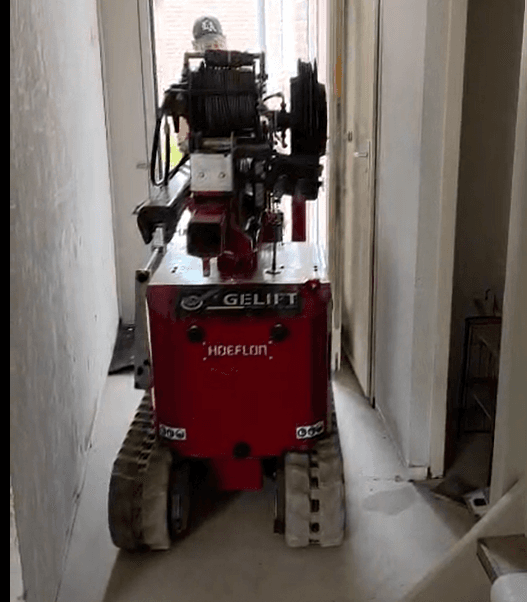
Compact tracked cranes are built to fold down through a doorway and drive to the work position under their own power. Rubber tracks spread weight over a larger area than wheels, which matters on an existing floor.
The electric models are what make it viable. With no combustion engine there are no emissions and little noise. That is not just pleasant - inside an enclosed space a diesel engine is simply not an option.
What we assess beforehand
- Load capacity of the floor being driven over and set up on
- Clear passage: door width, thresholds, turns in the hallway
- What sits beneath the set-up position
- Whether protection is needed to preserve existing finishes
A crane that fits down the hallway but overloads the floor is not a solution. Those two questions belong together.
Working in a live building
At Snow World we set the crane up on the piste, in a hall open to visitors. That governs the whole approach: working hours around opening times, each phase closed out to a safe interim state, and no open structure left behind when leaving site.
In a building that stays open, operations set the work sequence. Not the other way round.
On snow, the ground adds to it: soft, slick and not level. Spreader plates and controlled load build-up are not extra care at that point - they are necessary.
Where it cannot be done
Sometimes the answer is no. A floor that cannot take the point load, a passage too narrow, a load that has to go too far from the mast. Then we find another method - dismantling and bringing it in sections, or splitting the steel into pieces joined on site. What we do not do is try it anyway.