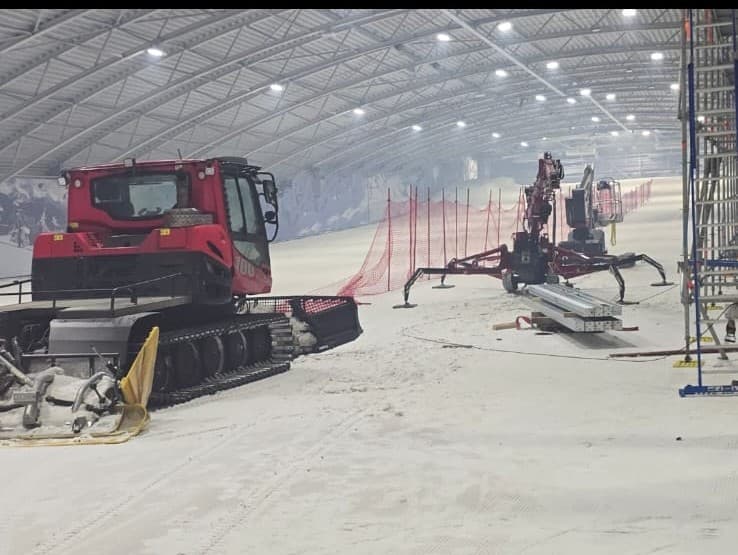
At Snow World an existing structure had to carry heavier cooling plant without shutting the business down. What that means for phasing.
The ski hall opens on Monday as normal. The cooling plant has to go in, the structure needs strengthening, and there are visitors on the piste.
Industrial cooling plant imposes a permanent load that a building's original design almost never accounted for. Snow World was no exception: the existing structure hadn't been calculated for what was being added.
What makes this kind of work interesting isn't the reinforcement itself. Adding steel where more capacity is needed is straightforward work. The difficulty is that the building stays open throughout.
Calculate first, then decide what's needed
The first step is assessing the existing structure against the new loading. That sounds obvious, but the result often isn't: part of the existing frame frequently turns out to be more than adequate, while other points need more than expected.
Without that assessment, everything gets reinforced as standard. That costs more, takes longer, and produces a structure heavier than it needs to be - with knock-on consequences for foundation loading.
Operations set the phasing
In a building that stays open, opening hours set the work sequence. Not the other way round. That means every phase has to end in a stable condition where visitors are safe - not in a half-built structure to be finished tomorrow.
- Each phase closed out to a stable interim state
- Works matched to opening hours and the cooling contractor's programme
- No open structure left behind when leaving site
- Transfer of concentrated load into the primary frame detailed in advance
Where the load actually lands
Cooling plant hangs or sits on a limited number of points. That means concentrated point loads on a structure originally designed for uniformly distributed loading.
So the question isn't only whether the structure can take the total weight, but whether it can take it at those points. That detail - transferring the point load into the primary frame - is where this work stands or falls.
The reinforcement isn't the hard part. The hard part is the order you install it in while there are people in the building.
What a client can take from this
Anyone installing plant in an existing building is better off having the structural assessment done before the plant is selected. At that stage the weight and fixing points are still variables. Afterwards they aren't.
ProjectsSteel reinforcement - Snow World
Structural steel reinforcement supporting the installation of industrial cooling systems.